- Topic and outline
- Jeroen De Dauw and Claude
- Writing
- Jeroen De Dauw and Claude
- Editing
- Jeroen De Dauw and Claude
EU Project ECHOLOT Builds on NeoWiki
NeoWiki is the new open-source collaborative knowledge base built on MediaWiki, the platform behind Wikipedia. In this post and the demo below, you learn what it can do for you in the cultural heritage domain, and how the EU cultural heritage project ECHOLOT is backing it.
NeoWiki for cultural heritage
You can use NeoWiki as your system of record, or alongside your existing collection management system. Either way, it makes your data available in standard formats, such as EDM for Europeana.
Watch the NeoWiki demo below, or read the NeoWiki cultural heritage page or the NeoWiki introduction blog post.
Highlights from the video:
- 0:31 How NeoWiki builds upon the lessons of Semantic MediaWiki and Wikibase/Wikidata
- 4:50 How to model and catalog an artwork from scratch, with every edit versioned
- 11:59 How to query a collection with SPARQL, the standard query language for linked data
- 13:46 How to map your schemas to EDM and CIDOC CRM for RDF export and SPARQL queries
What is ECHOLOT?
ECHOLOT (European Cultural Heritage Optimised Linked Open Tools) is a project in the EU's Horizon Europe program. It runs through 2028 and develops open-source tools that help museums, archives and libraries enrich, connect and share their data.
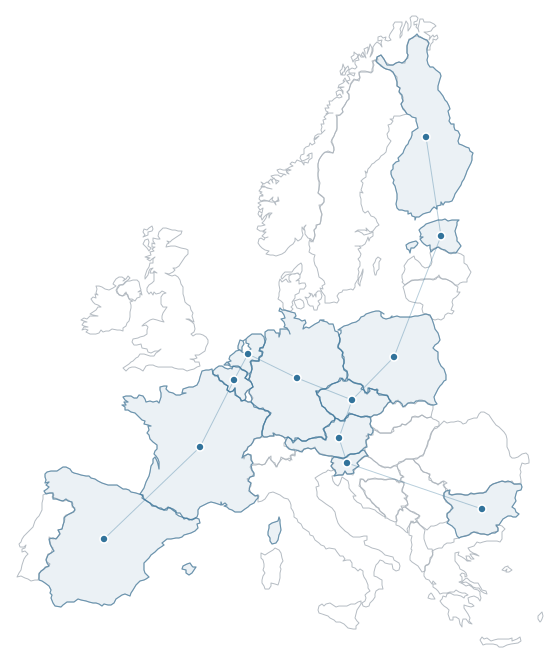
The consortium has 15 partners in 12 countries. It is led by TIB, the Leibniz Information Centre for Science and Technology, and includes Europeana, the Austrian Academy of Sciences and the University of Helsinki.
NeoWiki, our open-source MediaWiki extension for structured data, is the foundation of ECHOLOT's core system, the environment in which institutions curate their data. We lead the ECHOLOT work package in which we build that core system together with TIB and KMA.
Other partners add workflows on top of NeoWiki that let you match records against authority files (shared reference lists of people, places and subjects) and enrich them, with or without AI. A main goal of ECHOLOT is to make publishing enriched data to Europeana and Wikidata much easier.
 Funded by the European Union

Follow ECHOLOT through its newsletter, or on LinkedIn, Mastodon or Bluesky.
Tested with real collection data
ECHOLOT validates its tools in five case studies. In September, people from four of them tested NeoWiki hands-on with their own data, in sessions we ran with TIB. We found many opportunities for improvement, most of which have since been addressed. One of the key gaps we identified was imprecise dates, such as a year with no month or day, which we're currently implementing.
From 2027, the case studies will test ECHOLOT's system on collections from institutions such as the ZKM Center for Art and Media in Karlsruhe, Sweden's Nationalmuseum and the Royal Museum of Fine Arts Antwerp.
NeoWiki beyond ECHOLOT
ECHOLOT funds much of the work on NeoWiki's roadmap. Because all of NeoWiki is open source, everyone can use those features and refinements.
Hallo Welt!, the company behind the enterprise MediaWiki distribution BlueSpice, chose NeoWiki as the structured-data layer of BlueSpice Galaxy, its new knowledge management platform, and has funded the integration.
A common concern with EU projects is that their outputs turn into abandonware at the end of the project. With NeoWiki, which predates ECHOLOT, we have funding from multiple sources, and are set on long-term maintenance, as we have done for Semantic MediaWiki for over a decade and for our Wikibase extensions. Furthermore, your data is never locked in, due to the open-source nature of NeoWiki, and the wide range of export options in standard formats.
Running Semantic MediaWiki or Wikibase today? Read what NeoWiki means for SMW users and for Wikibase users.
What comes next
We released version 0.1 in October and expect a production-ready 1.0 release in the next few weeks.
Expect advanced dates, controlled vocabularies, RDFS export and multilingual schema labels in the near future. These will first land on master and then be released as additional 0.x releases ahead of 1.0. A migration path is guaranteed, so you can try it now and switch to 1.0 or later without hassle.
We will continue development throughout 2027 and are planning many new capabilities including:
- Bundles of ready-made schemas and ontology mappings that you install in one step, so you do not have to model your data from scratch. ECHOLOT is preparing such bundles for cultural heritage use cases.
- Enhanced import capabilities, including RDF import and bulk-import tooling. (You can already load your existing data through the REST API)
- In-wiki visualization of query results
Find more in the announcement post's roadmap.
Try NeoWiki
The easiest way to try NeoWiki is to create an account on neowiki.dev, the demo wiki. After confirming your account you can edit. This demo wiki periodically gets cleaned, so don't be afraid to make a mess or break something.
Contact us to pilot it in your organization, on your own MediaWiki (1.43 or later) or on our hosting. To hear about new releases, sign up for email updates.